SHOULDER PAIN – IMPINGEMENT / INSTABILITY
1. DEFINITION & ANATOMY
Shoulder pain is a common issue stemming from the joint’s unique design, which prioritises a vast range of motion over inherent stability. The shoulder is a complex ball-and-socket joint (the glenohumeral joint) where the head of the upper arm bone (humerus) sits in a shallow socket (the glenoid) on the shoulder blade (scapula). This mobility is managed by a group of four muscles and their tendons known as the rotator cuff, which act like dynamic ligaments to control movement and keep the joint centred. The whole complex is stabilised by the labrum (a cartilage rim that deepens the socket), ligaments, and a bursa that reduces friction.
Two main problems often arise, which can exist together:
- Shoulder Impingement (Subacromial Pain Syndrome): This occurs when soft tissues, such as the rotator cuff tendons or the bursa, get pinched or compressed in the narrow space (subacromial space) beneath the bony arch of the shoulder (the acromion).
- Shoulder Instability: This describes a situation where the humeral head moves excessively within the socket, ranging from subtle “micro-instability” to a full dislocation.
Common conditions we treat include:
- Rotator Cuff Tendinopathy/Tears: Irritation, inflammation, or damage to the rotator cuff tendons, often the supraspinatus tendon.
- Subacromial Bursitis: Inflammation of the bursa that sits between the rotator cuff and the acromion.
- Shoulder Instability: Often follows a traumatic dislocation or can develop over time in those with ligamentous laxity.
- Labral Tears (e.g., SLAP tear): Damage to the cartilage rim of the socket, which can affect stability and cause clicking or catching.
- Biceps Tendinopathy: Inflammation of the long head of the biceps tendon as it passes through the front of the shoulder.
2. SYMPTOMS & SIGNS
- Pain Location: Often felt as an ache over the front or side of the shoulder, which can radiate down the arm, typically not past the elbow. Instability may present as a less specific, deep-seated ache.
- Painful Arc: A classic sign of impingement where pain occurs as you lift your arm out to the side, typically between 60 and 120 degrees of elevation.
- Pain at Night: Difficulty sleeping on the affected side is a very common complaint, especially with rotator cuff issues.
- Weakness or Difficulty with Overhead Activities: Pain and/or weakness when reaching overhead, behind your back (e.g., doing up a bra), or lifting objects.
- Feelings of Instability: A sense of the shoulder feeling “loose,” “slipping,” or “giving way,” particularly in certain positions like throwing.
- Clicking, Popping, or Grinding: Mechanical sounds during movement can be associated with labral tears, instability, or degenerative changes.
- Red Flags: Inability to lift the arm after a fall or trauma could indicate a large rotator cuff tear. Numbness or tingling down the entire arm could suggest a nerve issue originating from the neck or shoulder.
3. CAUSES & RISK FACTORS
- Repetitive Overhead Activity: Common in sports like swimming, tennis, and volleyball, or occupations like painting and construction.
- Poor Posture: A forward-slumped posture can narrow the subacromial space, predisposing you to impingement.
- Muscle Imbalances: Weakness in the rotator cuff or the muscles that stabilise the shoulder blade (scapular stabilisers) can lead to poor joint mechanics.
- Sudden Injury: A fall onto an outstretched hand or a direct blow to the shoulder can cause traumatic tears, dislocations, or labral damage.
- Age-related Changes: Degenerative changes in the tendons can make them more susceptible to injury.
- Joint Laxity (Hypermobility): Naturally loose joints can predispose individuals to instability.
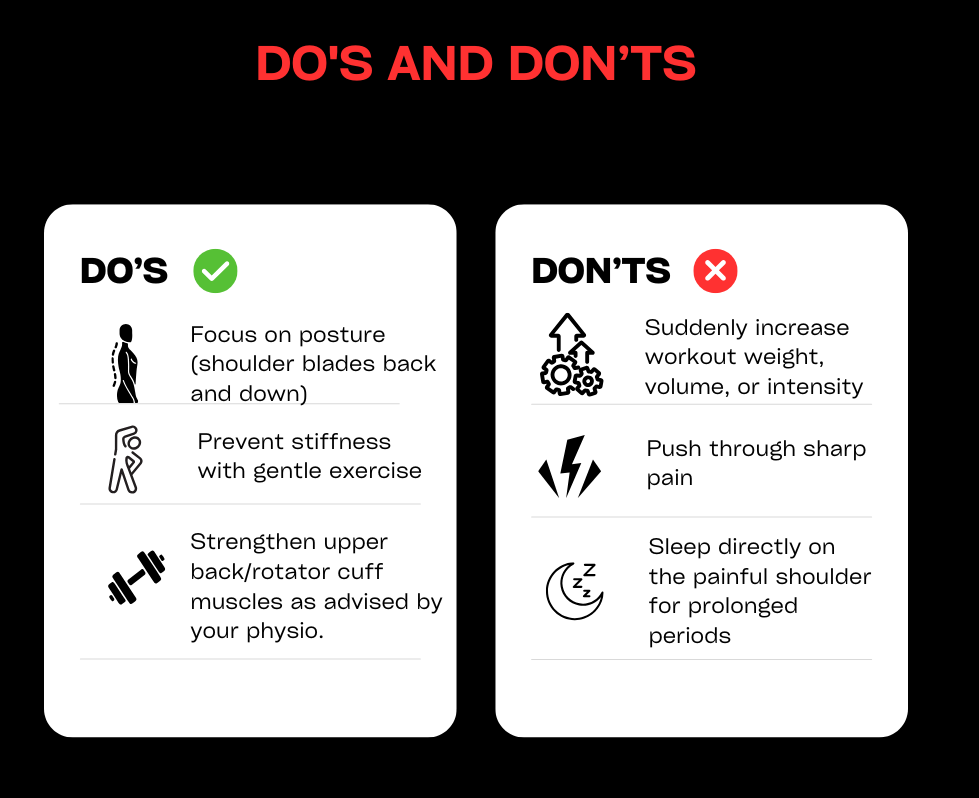
- Sudden Overload: A sudden increase in gym weights, a weekend of DIY, or an unaccustomed heavy lift.
4. HOW PHYSIOTHERAPY HELPS
- Assessment: Our first step is a comprehensive diagnosis. We take a detailed history of your symptoms and activities. The physical examination involves a series of movement tests and special clinical tests to identify which structures are involved (rotator cuff, bursa, labrum). We assess your posture, shoulder blade control, strength, and range of motion to find the root cause of the problem.
- Manual Therapy: We use hands-on techniques such as soft-tissue release for tight pectoral, upper back, and rotator cuff muscles. Joint mobilisations for the shoulder, thoracic spine, and neck can be used to restore normal movement and reduce stiffness.
- Exercise Therapy: This is the core of effective shoulder rehabilitation. You will receive a bespoke, progressive exercise programme designed to:
- Strengthen the rotator cuff and scapular stabilising muscles.
- Improve postural awareness and control.
- Restore full, pain-free range of motion.
- For instability, focus on dynamic control to keep the joint centred and secure.
- Education & Habit Change: Understanding your condition is key. We will educate you on which movements to temporarily avoid, how to modify your activities at work or in the gym, and provide ergonomic and postural advice to prevent recurrence.
- Adjuncts: Where appropriate, we may use taping techniques to support the shoulder or improve postural awareness. For persistent tendinopathies, shockwave therapy can be a highly effective treatment to stimulate healing, which we can provide in-clinic. If a significant structural injury is suspected, we can refer you to your GP or a specialist for imaging.
5. TIMELINE / EXPECTED RECOVERY
- Impingement / Bursitis / Mild Tendinopathy: With a consistent physiotherapy programme and activity modification, symptoms often start to improve significantly within 4-6 weeks.
- Chronic Rotator Cuff Tendinopathy: These can be more stubborn and often require a dedicated strengthening programme over 8-12 weeks or longer for full resolution.
- Instability: Rehabilitating an unstable shoulder focuses on building robust muscular control. This is a longer process, typically taking 3-6 months of consistent work.
- Post-Surgical Rehab: Following an operation (e.g., for a large tear or stabilisation), recovery is guided by the surgeon’s protocol but often spans 6-12 months.
6. SELF-HELP & PREVENTION
- During a Flare-up: Avoid repetitive overhead lifting and activities that cause sharp pain. Try to avoid sleeping directly on the painful shoulder; using pillows to prop yourself can help. Apply ice for 15 minutes to the painful area after activity.
- Gentle Movement: Perform gentle, pain-free pendulum swings and active-assisted movements (using your good arm to help the painful one) to maintain mobility.
- Build a Routine: To prevent future issues, focus on posture. Regularly stretch your chest muscles and incorporate strengthening exercises for your upper back and rotator cuff into your fitness routine 2-3 times per week.
7. WHEN TO SEE A PHYSIO OR SPECIALIST
If you feel in doubt about your diagnosis or your shoulder problem is not resolving book a physiotherapy assessment with one of our physiotherapists.
Finding the underlying cause of shoulder problems can be difficult, but our experienced team is here to help. Book an appointment to see us today with your shoulder pain.