1. DEFINITION & ANATOMY
Neck pain is an incredibly common issue, stemming from the complex and mobile structure of your cervical spine. Your neck is composed of seven vertebrae (C1–C7), separated by shock-absorbing intervertebral discs and guided by small facet joints. A network of ligaments provides stability, while key muscles – like the deep neck flexors in the front, scalenes at the side, and the upper trapezius, levator scapulae, and suboccipitals at the back – control movement and support your head. Nerve roots exit from the spine at each level to supply your shoulders, arms, and hands. Posture and stress levels have a significant influence on the health of this entire system.
Common categories of neck pain include:
- Non-Specific or Mechanical Neck Pain: The most frequent type, involving general ache and stiffness from muscular strain or joint irritation without a specific structural cause.
- Whiplash-Associated Disorders (WAD): An injury caused by a rapid back-and-forth movement of the head, often from a car accident.
- Cervical Spondylosis: Age-related wear and tear or arthritis in the joints and discs of the neck.
- Acute Torticollis: A sudden, painful spasm of the neck muscles that causes the head to be stuck tilted to one side, often noticed upon waking.
- Cervical Radiculopathy: Irritation or compression of a nerve root as it leaves the spine, causing pain, tingling, or weakness to radiate into the arm.
- Cervicogenic Headache: Headaches that originate from a problem within the neck joints or muscles.
2. SYMPTOMS & SIGNS
- A persistent dull ache or stiffness localised to the neck.
- A sharp, catching pain when turning your head.
- Reduced range of motion, especially with rotation (looking over your shoulder) or side-bending (tilting your ear to your shoulder).
- Morning stiffness that eases with gentle movement.
- Pain that worsens after prolonged desk work, driving, or looking down at your phone.
- Noticeable muscle spasm or tightness, particularly in the upper shoulders (trapezius).
- Pain that refers down into the shoulder blade or upper back.
- Headaches, especially at the base of the skull or wrapping around to the temples.
- Arm symptoms such as tingling, pins and needles, numbness, or weakness (indicative of nerve irritation).
- Pain that is aggravated by poor pillow support during sleep.
- Relief with gentle movement, stretching, or applying a heat pack.
3. CAUSES & RISK FACTORS
- Prolonged Sitting & Screen Time: Sustained postures, especially with a forward head position, overload neck structures.
- Poor Ergonomics: A workstation or driving setup that encourages slouching.
- Previous Neck Injury: A history of trauma, such as whiplash, can predispose you to future episodes.
- Deconditioning: Weakness in the deep neck flexor muscles and the muscles around your shoulder blades.
- Stress, Anxiety, and Poor Sleep: These factors increase muscle tension and pain sensitivity.
- Age-Related Changes: Degenerative processes (spondylosis) are a normal part of ageing but can sometimes become symptomatic.
- Contact Sports or High-Impact Activities.
- Generalised Joint Hypermobility.
- High Phone Use: The classic “text neck” posture places significant strain on the cervical spine.
4. HOW PHYSIOTHERAPY HELPS
- Assessment: We perform a thorough assessment to screen for any red flags and classify the source of your pain. This includes checking your range of motion, joint mobility, and muscle performance, including the endurance of your deep neck flexors (DNFs) and scapular control. If you have arm symptoms, a neurological screen is essential. We will liaise with your GP if imaging is required.
- Manual Therapy: We use hands-on techniques such as cervical and thoracic spine mobilisations (or manipulation where appropriate) to restore joint movement. This is complemented by soft-tissue release for tight and tender muscles like the upper trapezius, levator scapulae, scalenes, and suboccipitals.
- Exercise Therapy: You will receive a graded exercise programme tailored to your needs. This often starts with activating the deep neck flexors and strengthening the key scapular muscles (mid/lower traps, serratus anterior). We will also prescribe mobility drills and, if appropriate, gentle nerve gliding exercises for radicular symptoms. The overall goal is to build postural endurance and resilience.
- Education & Habit Change: A crucial part of recovery is learning to manage your condition. We provide education on pain science, activity pacing, and the importance of posture breaks (using the 20-8-2 rule). We offer specific advice on workstation setup, pillow selection, sleep positions, and phone ergonomics. We can also provide strategies for stress management and breathing.
- Adjuncts: We may use taping for postural feedback or short-term relief, and provide guidance on using heat or ice. If needed, we will coordinate with your GP regarding pain medication or referral to a specialist.
5. TIMELINE / EXPECTED RECOVERY
- Mechanical Neck Pain: Most acute episodes of simple neck strain or stiffness respond well to physiotherapy, with significant improvement within 2–6 weeks.
- Whiplash-Associated Disorders: Recovery can be more variable but typically takes between 6–12 weeks. An active, graded approach is key.
- Radicular Symptoms: Nerve-related pain can take longer to settle, often requiring 6–12 weeks or more for the nerve to calm down and for strength to be restored.
- Cervical Spondylosis: As this is a chronic condition, management focuses on strengthening, maintaining mobility, and developing strategies to control flare-ups effectively.
- Flare-ups are common with neck pain, but physiotherapy empowers you with self-management skills to control them faster.
6. SELF-HELP & PREVENTION
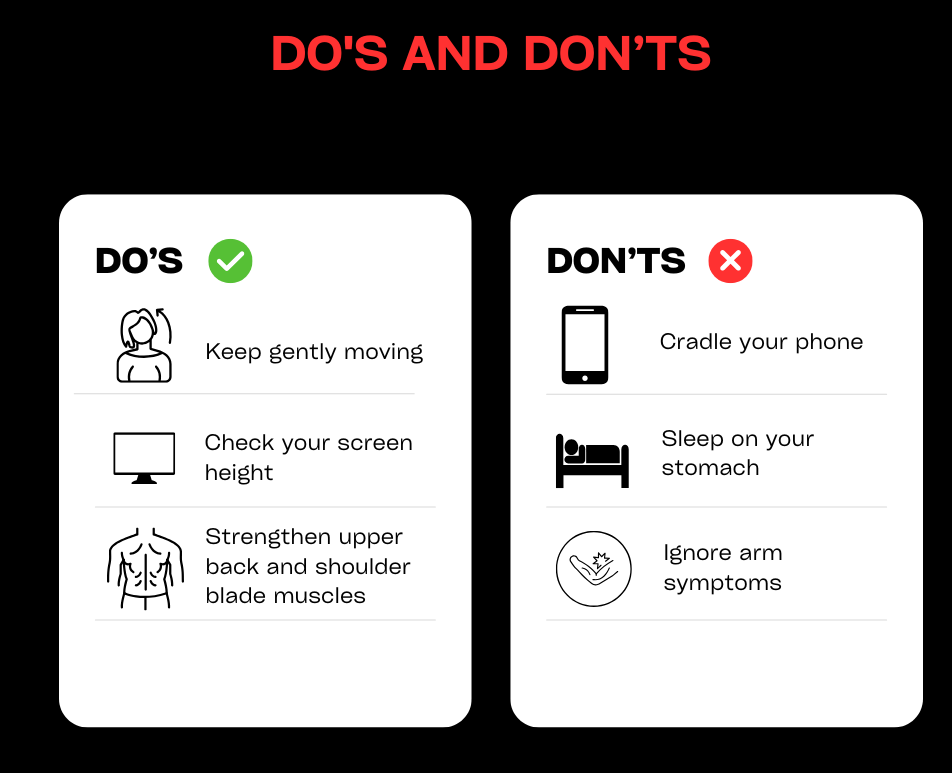
- During a Flare-up: Aim for relative rest but avoid complete immobility. Avoid sustained end-range postures (e.g., looking down for long periods). Perform gentle range of motion exercises like chin tucks and slow head rotations. A heat pack can be very effective for muscular pain.
- Take Micro-Breaks: Get up and move frequently. Short walks and gentle stretches can prevent stiffness from setting in.
- Build a Routine: Incorporate a simple strengthening programme for your neck and scapular muscles 2–3 times per week. Daily mobility drills can also help maintain flexibility.
- Optimise Your Ergonomics: Use a headset for long phone calls. Raise your laptop or monitor screen to eye level. Ensure your pillow supports your neck in a neutral position.
7. WHEN TO SEE A PHYSIO OR SPECIALIST
If you feel in doubt about your diagnosis or your neck problem is not resolving book a physiotherapy assessment with one of our physiotherapists.
Get moving and reduce pain quickly. Book an appointment with one of our physios.